Key Takeaways:
- Raleigh and the Triangle are experiencing unprecedented growth driven by over $10 billion in committed capital for healthcare, life sciences, and infrastructure megaprojects.
- Major health systems like UNC Health, Duke Health, and WakeMed are making massive investments, signaling robust population growth and expanding a complete ring of services around Raleigh.
- Emerging towns like Wendell, Knightdale, and Fuquay Varina offer current value plays in real estate, positioned for growth before prices fully reflect the incoming infrastructure and job creation.
Table of Contents
- Raleigh’s Quiet Billion-Dollar Boom
- Healthcare Investment: A Signal of Growth
- Life Sciences: Powering the Triangle Economy
- Emerging Growth & Value Plays
- Infrastructure and Talent: The Bedrock of Sustained Growth
- Navigating Today’s Evolving Raleigh Real Estate Market
Raleigh’s Quiet Billion-Dollar Boom
I’ve been in this market for 10 years, and I’ve never seen the level of committed capital hitting one metro at the same time as we’re witnessing in Raleigh and the wider Triangle today. While other cities grab headlines, Raleigh has quietly attracted over $10 billion in a single year through a series of Raleigh area megaprojects already underway. These are not just plans; they are shovel-ready, fully funded developments poised to reshape our region and, frankly, the entire Southeast.
When major health systems, global life sciences giants, and transportation agencies all commit billions to the same metropolitan area, the trajectory of growth is firmly established. It signals a profound shift, one that is critical for anyone looking to buy, sell, or invest in Raleigh-area real estate to understand. My clients and I track these institutional investments closely, as they are the truest indicators of future population growth and economic vitality.
Healthcare Investment: A Signal of Growth
Healthcare systems don’t make multi-billion-dollar decisions on a whim; they have sophisticated teams modeling population growth, migration patterns, and long-term demand. So, when multiple major health systems break ground simultaneously in the Triangle, it’s a powerful signal. In January 2025, UNC Health and Duke Health announced a groundbreaking partnership to build North Carolina’s first free-standing children’s hospital, a $2 billion investment. This massive campus, located on 230 acres in Apex at the intersection of US 1 and NC 540 within the Veridia master-planned development, is expected to bring over 8,000 jobs to southwestern Wake County when construction begins in 2027.
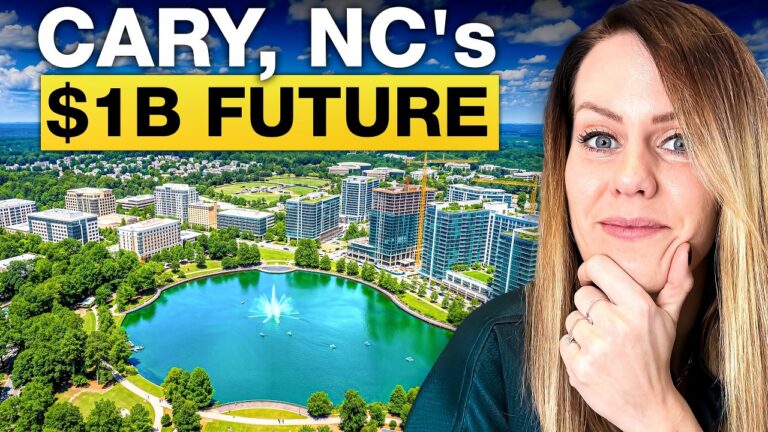
Beyond this joint venture, individual systems are expanding significantly. Duke Health broke ground in June 2025 on a major $540 million expansion of its Cary campus, adding a full emergency department, surgical services, imaging, cancer care, and inpatient beds, projected to employ about 1,600 people when fully built out. For more on what this means for local homeowners, I recommend exploring what these Cary NC home values will look like with such development. WakeMed followed in November 2025, initiating a 56-acre whole health campus in Garner, featuring a 150-bed mental health hospital and an acute care hospital embedded in a mixed-use community. Further strengthening the regional network, WakeMed is targeting Fuquay Varina with a free-standing emergency department, while UNC Health is expanding Holly Springs Hospital and UNC Health Rex has filed for a new community hospital in Wake Forest. This concerted, simultaneous investment across Apex, Cary, Garner, Fuquay Varina, Holly Springs, and Wake Forest forms a complete ring of enhanced medical access around Raleigh.
Life Sciences: Powering the Triangle Economy
The Research Triangle’s life sciences sector is an economic engine that doesn’t get nearly enough national attention, despite being the fourth largest life sciences market in the United States. In a single recent year, North Carolina attracted over $10 billion in life sciences manufacturing investment alone, with billions more following. For instance, Fujifilm Diosynth Biotechnologies opened the largest commercial-scale cell culture biomanufacturing facility in North Carolina in September 2025 in Holly Springs, representing a total investment reaching $3.2 billion, with a second facility already under construction.
Global pharmaceutical giants are doubling down on their commitments here. Biogen announced an additional $2 billion investment in its Research Triangle Park manufacturing operations over the next three years, building on nearly $10 billion already invested since 1995. Even more significant, Novo Nordisk, known for Ozempic and Wegovy, committed $4.1 billion to expand its facility in Clayton, about 20 miles southeast of Raleigh. This is the single largest capital investment ever made in North Carolina’s life sciences sector, adding 1.4 million square feet of production space and 1,000 new jobs by 2029. These are the kinds of Raleigh area megaprojects that create sustained housing demand and economic stability.
Crucially, Research Triangle Park itself is undergoing a major transformation. For 65 years, RTP was purely an office and research hub. But in January 2025, companies voted to approve the first major amendment to its land covenants in history, allowing for residential neighborhoods, mixed-use districts, retail, and restaurants. This means that for the first time, people will be able to live, work, and socialize all within RTP, fundamentally changing its dynamic and further fueling demand for properties in surrounding areas.
Emerging Growth & Value Plays
For 10 years, I’ve watched how growth waves move through our market. The first wave hit established areas like North Raleigh and Cary. The second pushed into Apex, Holly Springs, and Wake Forest, where discounts quickly closed. The third wave, which is happening now, is moving toward the edges of the metro where infrastructure arrives before prices fully surge, creating current opportunities. This is where my clients and I are finding value.
Wendell, for example, is the most significant growth story in Wake County right now, with its population up around 70% since the 2020 census. Master-planned communities like Wendell Falls have already sold over 2,300 homes, and Brookfield has broken ground on Ponder, an adjacent community with over 1,900 additional homes opening in fall 2026. A 230-acre business park and a new shopping center are also underway, formalizing Wendell’s inclusion in Wake County’s transit vision. Similarly, Knightdale is set for a boom once the 540 outer loop’s eastern segment completes in 2028, connecting the town to RTP, Cary, and the airport with a clean highway run. Fuquay Varina, which historically faced criticism for long drives to medical care, is addressing this directly with a WakeMed outpatient facility slated for 2027. These are the areas where new construction neighborhoods are thriving, offering a different value proposition.
Infrastructure and Talent: The Bedrock of Sustained Growth
The scale of these Raleigh area megaprojects is underpinned by two critical factors: robust infrastructure development and a world-class talent pipeline. Raleigh is currently making two of its most consequential infrastructure investments simultaneously. The complete 540 project, the largest highway investment in NCDOT history, will extend the Triangle Expressway 28 miles, creating a six-lane outer beltway around the metro. Phase one opened in September 2024, and phase two, connecting I-40 to I-87 near Knightdale, is targeted for 2028. This will dramatically improve commutes for the 90,000+ Johnston County residents who work in Wake County and open new land corridors for residential development.
In parallel, Raleigh-Durham International Airport is undergoing a $2.5 billion, 10-year overhaul, Transform RDU, aiming to double annual passenger capacity from 15 million to 30 million. This commitment ensures our region remains globally connected. What gives this growth staying power is the talent pipeline from institutions like NC State, Duke, and UNC Chapel Hill, which collectively generate over $3 billion in annual federally funded research. This academic foundation, coupled with initiatives like Wake Tech’s new Eastern Wake campus focusing on robotics and biotech, continuously feeds the innovation economy and attracts companies.
Navigating Today’s Evolving Raleigh Real Estate Market
After several years of intense competition and rapid appreciation, the Raleigh real estate market has shifted towards a more balanced footing. I’ve observed that inventory in Wake County was significantly higher entering 2026, homes are sitting on the market longer than at the peak, and median prices have softened slightly from their highs. This isn’t a crash; it’s a normalization, which actually presents the best opportunity for buyers in some time.
Well-priced, well-positioned homes in desirable neighborhoods and strong school districts are still seeing significant activity, sometimes even multiple offers. However, properties that are overpriced or less desirable are sitting, highlighting the nuance of the current market. New construction tends to concentrate at higher price points, leaving the mid-range segments relatively tight. My experience helps clients understand this complexity to avoid Raleigh home buyer regrets. With an employer base expanding with billions more in committed capital coming online between now and 2029, the fundamentals pointing to future appreciation have only gotten stronger, solidifying the impact of these Raleigh area megaprojects on long-term value.
Frequently Asked Questions (FAQs)
Q: What are the most significant healthcare investments planned for the Raleigh area?
UNC Health and Duke Health are partnering on a $2 billion free-standing children’s hospital in Apex, projected to create 8,000 jobs by 2027. Duke Health is expanding its Cary campus with a $540 million project, adding an emergency department and beds. WakeMed is developing a 56-acre health campus in Garner, alongside plans for a free-standing emergency department in Fuquay Varina.
Q: How is the life sciences sector contributing to the Triangle’s growth?
The Research Triangle is the fourth largest life sciences market, attracting over $10 billion in manufacturing investment in a single year. Fujifilm Diosynth Biotechnologies opened a $3.2 billion biomanufacturing facility in Holly Springs. Novo Nordisk is making the largest capital investment in NC’s life sciences history, a $4.1 billion expansion in Clayton creating 1,000 jobs.
Q: What major infrastructure projects are transforming connectivity in the Triangle?
The complete 540 project, a $2.5 billion initiative, is the largest NCDOT highway investment, extending the Triangle Expressway 28 miles as an outer beltway, with phase two opening by 2028. Raleigh-Durham International Airport is undergoing a $2.5 billion overhaul, Transform RDU, to double passenger capacity to 30 million annually, enhancing global access.
Q: Which specific towns are currently considered real estate “value plays” around Raleigh?
Wendell, Knightdale, and Fuquay Varina are currently “value plays,” with homes often in the mid-upper $400,000s. Wendell’s population is up 70% since 2020, with thousands of new homes planned. Knightdale will benefit from the 540 outer loop completion by 2028, and Fuquay Varina is gaining a new WakeMed outpatient facility in 2027, improving medical access.
Thinking about buying or selling in the Raleigh area? Reach out to our team today to start your journey!
This article was adapted from our YouTube video: Raleigh, NC Insane Megaprojects That Will Transform The Southeast. Watch the full video here: https://www.youtube.com/watch?v=vI23Zbqvwhg